


Executive summary
Ontario Power Generation’s newly refurbished Darlington nuclear station is underperforming at a moment when the utility is asking ratepayers and government to support even larger nuclear commitments. With only one of four Darlington reactors operating this August, the situation raises questions about OPG’s operational reliability, rate-setting incentives, and broader role as Ontario’s publicly owned generator. This report argues that today’s concerns echo the conditions that led to the breakup of Ontario Hydro: escalating costs, weakening performance, opaque decision-making, and a public utility increasingly managed as a profit-seeking business rather than as a provider of power at cost. The immediate outage issue may prove explainable, but unless OPG is transparent about Darlington’s performance and the financial incentives embedded in its regulated rates, the political and public narrative around expensive, unreliable nuclear power could again become dangerous for Ontario’s electricity system.
Key findings
· Darlington’s post-refurbishment performance is raising reliability concerns, with only one of four reactors operating during August despite the project’s recent completion.
· OPG’s public communications have not adequately explained the recent outages, leaving room for speculation about whether they reflect technical problems, maintenance timing, financial incentives, or some combination of these factors.
· The utility’s regulated rate structure may reward higher costs, lower production forecasts, and retained earnings growth, creating incentives that do not align neatly with ratepayer interests.
· Current concerns echo the late Ontario Hydro period, when nuclear cost overruns, weakening performance, and governance choices damaged public and political confidence in the utility.
· As OPG pursues small modular reactors, Pickering refurbishment, and possible new nuclear development, stronger transparency and accountability are needed before Ontario commits to further large-scale nuclear spending.
These findings point to a larger question than whether Darlington is simply having a bad month. The issue is whether Ontario’s publicly owned generator is still being governed, regulated, and explained to the public in a way that serves ratepayers first. That question begins with the immediate facts at Darlington, but it quickly leads back to the history Ontario has already lived through once: a nuclear-heavy public utility whose cost, performance, and institutional purpose became politically unsustainable.
Introduction
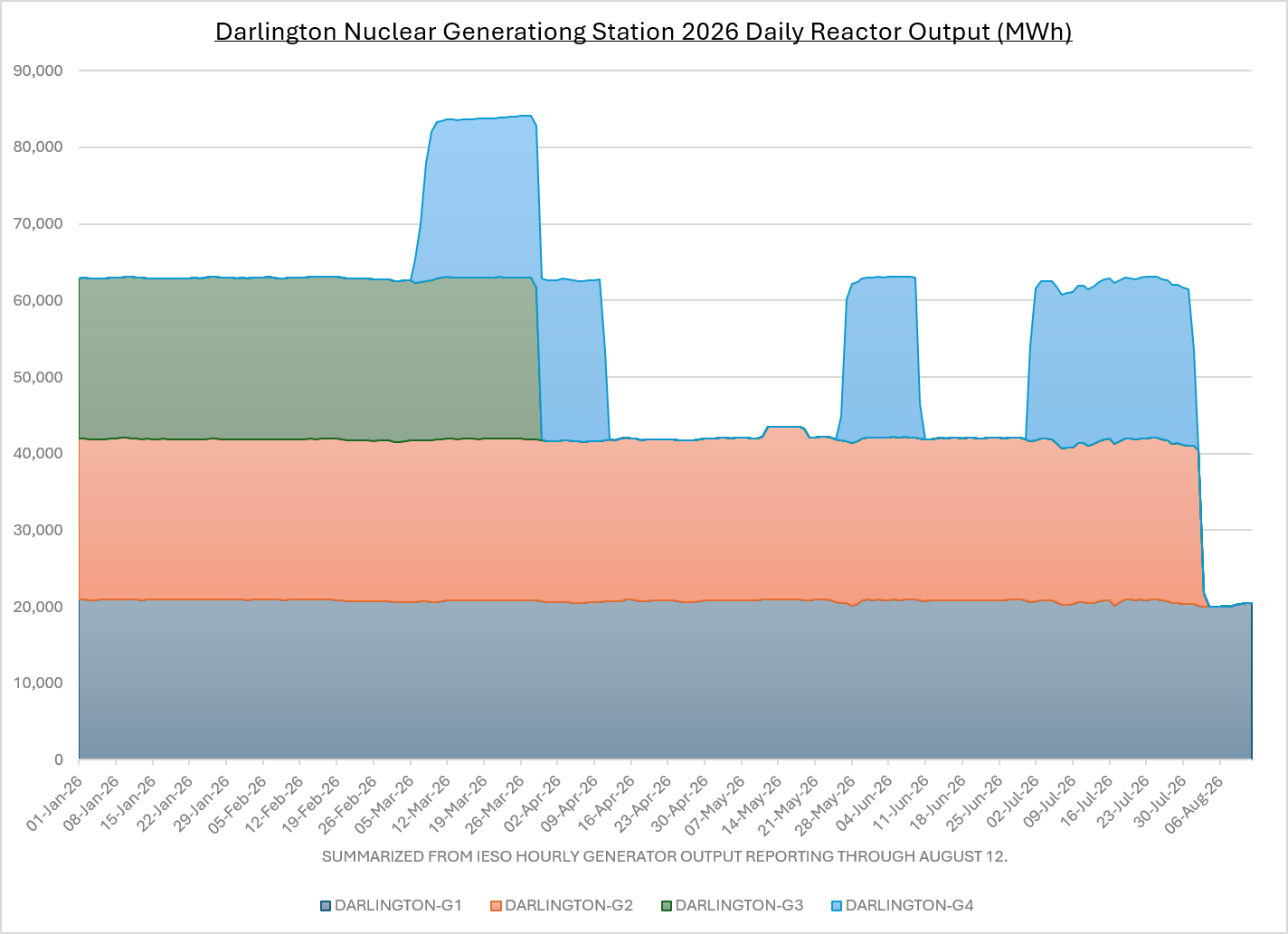
Ontario Power Generation (OPG) was celebrated for completing the refurbishment of its Darlington nuclear generating station (DNGS) early this year, but today only one of the four reactors at the facility is operating. Two units dropped out of service in the first few days of August.[1] OPG is in the process of spending billions of dollars at building first-of-a-kind (FOAK) small modular reactors (SMR’s), planning to spend even more on the refurbishment of the older, smaller, Pickering Nuclear Generation Station, planning for what could become the largest nuclear generating station on earth, and sharply escalating pricing to consumers. The apparent failures at reactors in its touted DNGS refurbishment should raise alarm bells about OPG’s performance and a re-examination of its purpose.
A 25% summer capacity factor for a nuclear site is historically terrible, although it may have extenuating circumstances. OPG’s other nuclear generating station, Pickering (PNGS), is set to be taken out of service (for a long-duration refurbishment) at the end of September. It is possible OPG moved up some maintenance tasks to occur while PNGS was being productive, although there was no indication in the system operator’s (IESO) reporting that the two recent outages were planned. It is possible that OPG is tanking their 2026 results to avoid consumers benefitting from the very high profits reported in recent years – and I’ll explain later that it is a certainty the government has acted to prevent this. The reality is likely a combination of all three things – an unexpected trip causing an outage that gets expanded to address other issues because the loss of revenue would best be taken sooner. Speculation need not to be invited – OPG could just inform the public when units go offline- so the only certainty is that only one of four newly refurbished reactors is generating power this August.
On February 2nd of this year OPG announced, “Darlington Refurbishment construction completed ahead of schedule, under budget”.[i][1]
The latest OPG financial reporting[2], for the second quarter of 2026, notes the refurbishment period of unit 4 (G4) ended March 12th. Since that date the DNGS has had all 4 units producing power for 18 days. Unit 4, the final unit to return from the lengthy life-extension, has operated on only half of the days since its feted return to service.
To understand the danger DNGS’s current performance presents to Ontario, and its nuclear industry in particular, it will be helpful to revisit:
1. the dissolution of Ontario Hydro in the 1990’s;
2. the changing position of Ontario Power Generation as it emerged as the public generator in a so-called market era, and emergence of Bruce Power;
3. the financial drivers of OPG’s rates
Each of these three subjects deserves a broader look than the summaries I will provide, but the short reviews may suffice to show my concerns with OPG’s performance, rates, and viability as an ongoing entity.
The Wreck of Ontario Hydro
In the beginning there was the Hydro-Electric Power Commission of Ontario (HEPCO). HEPCO had grown out of a desire for public power founded on the principles of “the gifts of nature are for the public”, and the spreading of electrification across the province. By the end of the 1950’s additional hydro power was seen as scarce[3], and options came to be seen as coal, and then nuclear. The initial nuclear projects, and particularly Pickering’s first 2 reactors, were specifically based on the premise of lower operating costs than coal – under the expectation finite resources would continue to see fuel costs escalate. By the middle of the 1970’s, when the ruling Progressive Conservative party was reduced to a minority government, concerns about nuclear’s costs had grown alongside the blossoming of Amory Lovins’ soft path ideology. A Royal Commission on Electric Power Planning was established at the time, reporting in 1980. That work questioned the aggressive growth assumption of what had become Ontario Hydro – while not overtly hostile to nuclear, it could be seen as strengthening the soft path forces within Ontario.
In 1981 the PC’s regained their majority government under Bill Davis, and immediately pushed into the construction of Darlington.[4] By the time the PC’s were pushed out of power in 1985, a committee on finishing the station, established by their successors, only held up construction – basically concluding the sunk costs made completing all 4 units a responsible decision. The Liberal party of the Premier had campaigned on halting Darlington’s construction; it is speculated that the NDP party supporting the minority government of the Liberals, and their worry about the wealth of union jobs on the site, allowed work to proceed. In 1990 that NDP party won a majority – and they were done supporting nuclear. The Rae government immediately announced a moratorium on new nuclear builds, even as Darlington approached completion.
Maurice Strong was appointed as the head of Ontario Hydro 33 years ago – which is really the first flowering I’d note of the misguided idea that public power should operate as a business, as opposed to acting as a facilitator for businesses in the broader economy. The “Power at cost” philosophy was quickly forgotten. In Strong’s own words after 2 years in the job:
The large-scale restructuring we have carried out at Ontario Hydro has reduced our costs dramatically, we have scaled back our work force by more than one-third to the levels of more than forty years ago when our operations were only some ten percent of what they are now and moved from the largest loss in our history to the highest profit while capping our rates and even effecting some reductions for industrial customers.[5]
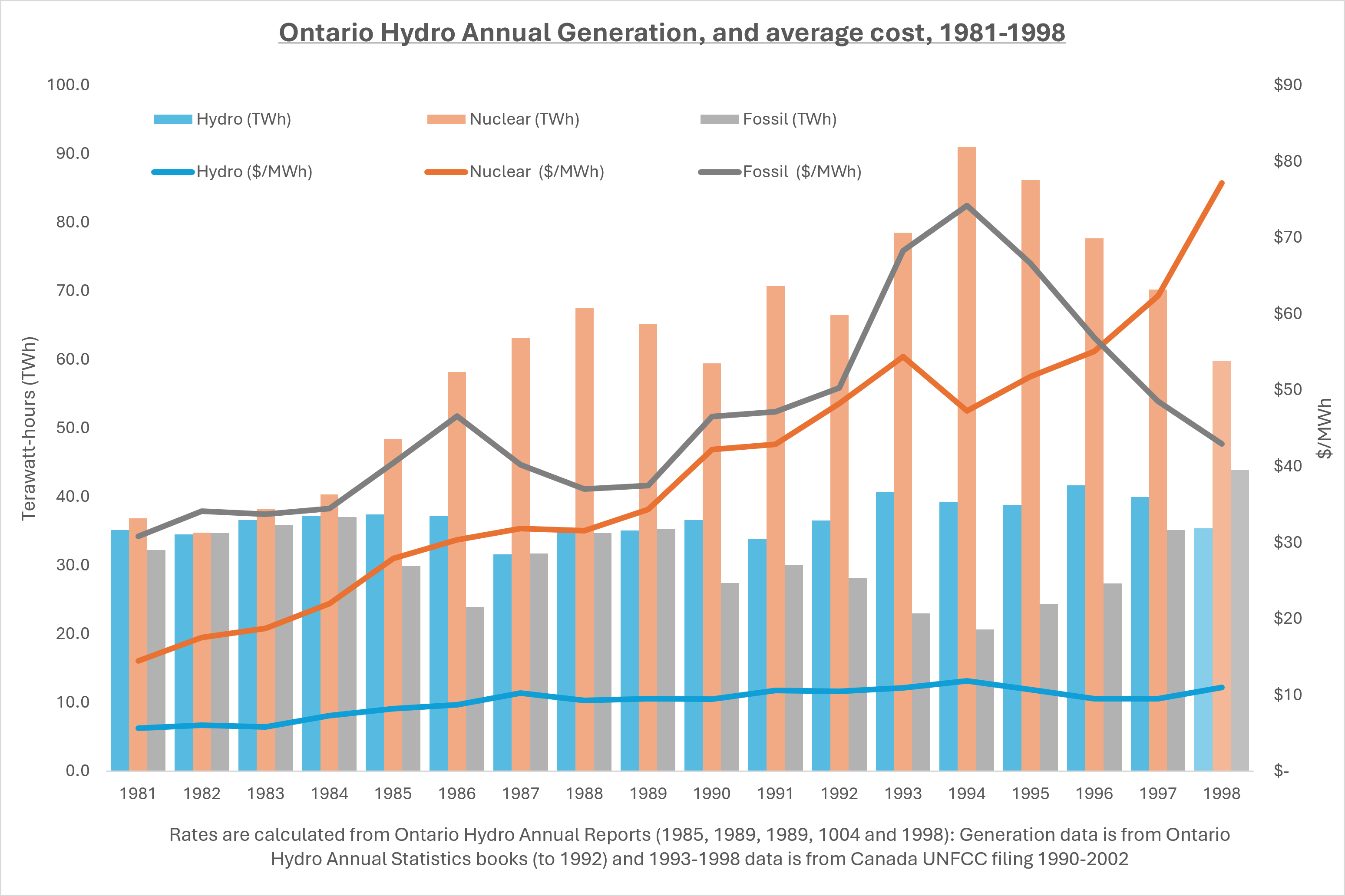
It’s a strange quote in that Ontario Hydro wasn’t allowed to make a profit. It was also not allowed to charge for a new generating asset until it entered service. Because of this the consumer saw double-digit rate hikes in the years Darlington’s reactors were brought online and construction costs entered the rate base. With that construction ended, and a moratorium on any new builds, it is unsurprising that jobs were eliminated. Evidence suggests the cuts went deeply into the muscle of Ontario Hydro. In Strong’s “Full Cost Accounting” nuclear maintenance rated lowly, and coal plants were seen as underutilized. Nuclear output dropped over one-third between 1994 (the first full year of a 4-reactor DNGS) and the 1998 end of Ontario Hydro. Eight reactors at the Bruce and Pickering “A” stations were laid up prior to the carve up of Ontario Hydro.
OPG’s changing role since market opening – featuring Bruce Power
The vision for a competitive market is that its pricing mechanism will signal oversupply or incent new entrants. When Ontario’s market experience began in May 2002, the province had been in a rate freeze since 1993. Demand was increasing, supply was not, and a hot summer saw frequent price spikes and worries of brownouts. By December a rate freeze was reintroduced, with a stated account of having the revenue from OPG above the cap price financing it.[1] Prior to the market opening a public outcry, supported by a union action in court, prevented the privatizing of any part of the transmission system under Hydro One, so the initial market experience further soured the public on the private power experiment. By the end of 2002 consumer rates had been frozen, removing the incentive for new merchant generators to enter the market.
Coal was a prominent share of OPG’s generation capacity as Ontario attempted the move to a market system. Government had frozen the sale of OPG coal-fired generators in 2000, and reportedly intervened to block the sale of two stations in the fall of 2002. After the market opened revenue from these stations was expected to subsidize the purchase of more expensive generation. The coal-fired power that was ramped up in the 90’s was the villain of the 2003 general election, with all parties running on the promise of phasing coal out; the winning Liberals were the party that promised to do it quickest.
Phasing out coal was difficult given the market struggles discouraged and new market entrants, and it was hoped the price-capped OPG would be selling assets to moderate its market power, not building more. In April of 2004 the Energy Minister, Dwight Duncan, sketched out plans for a new market system:
“... we will be introducing legislation for sweeping institutional reform that would see a combination of a fully regulated and a competitive electricity sector. There would be a split between regulated prices for electricity coming from major nuclear and baseload hydro generation assets, and a healthy, competitive market for all other generation. This combination of pricing mechanisms would result in a blended cost for consumers.
Ontario Power Generation’s nuclear and baseload hydroelectric assets would be regulated by the Ontario Energy Board, who would set regulated prices, while the wholesale price for other electricity generated in the province would be set by the market, which would continue to operate as it does now.
Fixed prices for a large part of the energy consumed in the province would keep the overall blended price for electricity relatively stable.”[2]
This plan would result in the Ontario Power Authority (OPA) to implement professional planning of Ontario’s power system, and give it the power to contract the new supply needed to displace the capacity provided by coal. The structural tool introduced to allow the full recovery of electricity supply costs from consumers became the “Global Adjustment” – a surcharge to balance revenue from the sale of supply on the market with the actual cost paid to suppliers. For Ontario nuclear, and its largest hydro stations, the cost paid would be regulated by the Ontario Energy Board (OEB) – once it got settled in doing it. The government first set the rates at 3.3 cents/kWh for the hydro stations, and 4.95 cents/kWh for OPG’s nuclear output, while the price of OPG’s unregulated assets received a 4.7 cent/kWh ($47/MWh) cap. Notably: “The prices on OPG’s regulated assets are based on projected costs of operation, plus a 5% return on equity.”[3]
The fixed, and limited, priced-power from OPG allowed the great spending of the Green Energy Act era. The new hybrid-market did initially meet the needs of contracted new supply to replace coal-fired power, but lobbyists realized a far greater potential. When the global Financial Crises hit, Ontario responded with an attempt to build the industries of the future in solar and wind power. It was an economic stimulus plan that would not add debt to the government as the global adjustment provided the tool for recovering all costs from consumers– with OPG assumed to continue limiting the rate impacts through regulated rates on much of its production.
A plan to ramp up electricity supply while demand was dropping had the foreseeable outcome of greatly dropping market pricing. This affected very few suppliers. Smaller hydro-electric facilities had been exposed to market pricing, but those not owned by OPG were quickly given contracts[1] with guaranteed rates. That essentially left OPG, the publicly owned remnant of Ontario Hydro, with generators exposed to a collapse in market price: coal (not a concern), and its unregulated hydro sites. In May of 2013 Parker Gallant and I collaborated on an article for the Financial Post: Ontario Power Generation turning water into debt.
“Once a relatively successful Crown corporation slated for privatization, OPG is now a contracting enterprise. The company’s hydro, fossil fuel and nuclear generating stations worth billions of dollars to taxpayers are now being eviscerated by policies that are stripping the company of its revenues and income-generating potential. Revenues have plummeted, asset values are sinking. Rather than being ripe for privatization, OPG is now under scrutiny by rating agencies such as Standard & Poor’s warning of cash flow problems and eroding value.” -May, 2013
By the end of 2013 OPG’s unregulated sites had been moved to receive regulated rates.
Supply changes over the life of OPG up until 2025 were mostly limited to the elimination of coal. Some major spending occurred on the Niagara tunnel project, and the Lower Mattagami project (which actually moved power to contracts), and OPG partnered in constructing the Portlands (gas) Generating Stations on the lands of Ontario Hydro’s historic Hearn plant. In general the desire for OPG to recede away from market dominance persisted for some time. It could not participate in the feed-in tariff contracts most wind and solar would get built on, and the Net Revenue Requirement (NRR) contract model seemed largely incompatible with the mandate of OPG. This did change somewhat in the Large Renewable Procurement (LRP) of March 2016, in which OPG partnered in a successful solar bid for its Nanticoke site – but this would be the last such contracting for many years. What changed significantly was OPG’s gas generating station fleet. A large Lennox Generating Station, capable of running on either natural gas or oil, remained from the Ontario Hydro period. In 2019 OPG announced the purchase of the natural gas plant interests of TransCanada Energy, giving it full ownership of Portlands, Brighton Beach, Napanee and Halton Hills facilities. This likely made OPG the largest owner of gas-fired power in Canada.
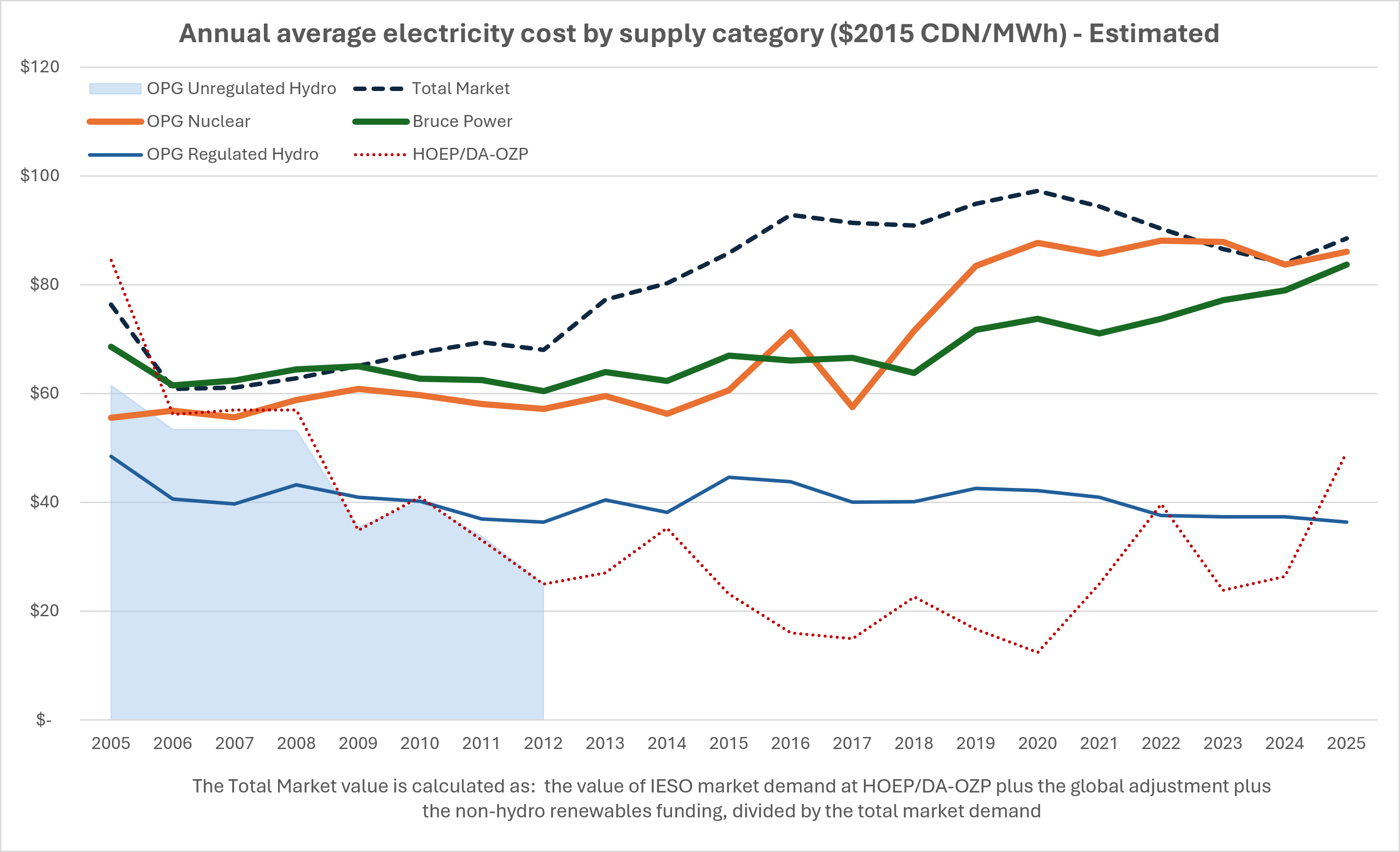
The rates paid for nuclear power were greatly influenced by two events as 2015 turned to 2016. Bruce Power and the government announced an agreement on refurbishing six units,[2] and a month later the announcement was made that refurbishment would commence at Darlington later in 2016 (and consideration giver to extending Pickering GS out to 2024).[3] Ontario’s news release on the Bruce extensions included, “The average price over the life of the contract is estimated to be $77/MWh,” and Bruce Power maintains a “Delivering Transparency and Trust” page that includes the projected, and annual, average rates (in $2015 CDN) out to 2063. The IESO’s announcement stated at that time, “The average cost of power from Darlington nuclear units post-refurbishment is estimated to range between $72/MWh and $81 MWh.” They do not maintain a page on forecasted and actual pricing.
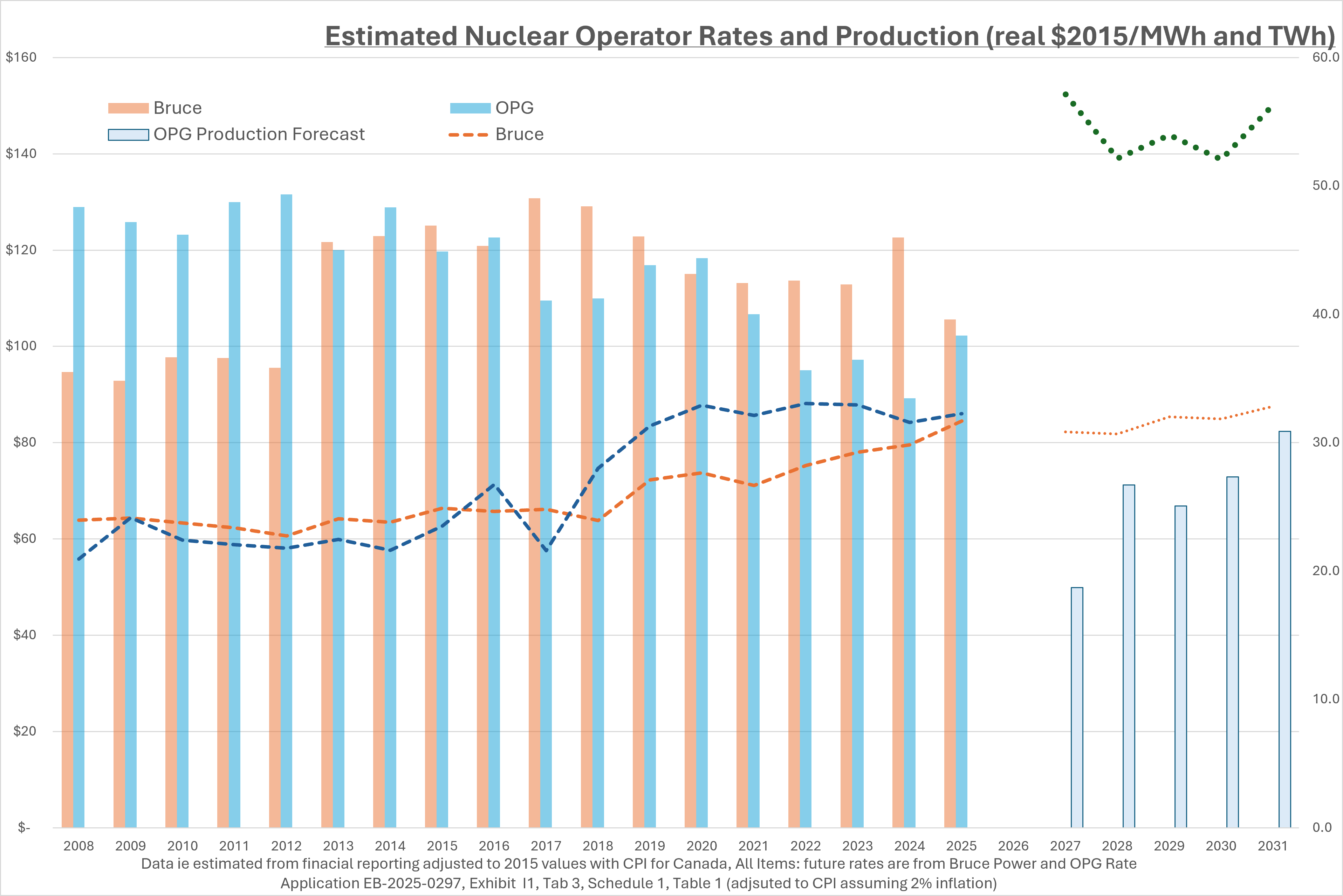
OPG’s pricing is determined by the Ontario Energy Board (OEB). The news release on the beginning of the Darlington refurbishment came shortly before OPG’s 2016 rate application[4]. Currently the OEB is considering OPG’s rate application for the coming 5 years. If approved, next year – the first when OPG will only have the fully refurbished Darlington plant to produce nuclear power – the real rate for nuclear power from Darlington will be double what was announced when the commencement of the refurbs was announced in 2016.
Fortunately, OPG ceased being Ontario’s largest producer of nuclear power over a decade ago.
The present environment for nuclear rates
Today, one of four reactors at the newly refurbished Darlington Nuclear Generating Station (DNGS) is operating. The reasons that OPG may have chosen to take these unannounced outages now, rather than in the future, deal with the pretence that the 100% government-owned entity is operating as a regulated business, and thus pursuing a profit motive. Explaining why OPG is well incented to be less productive now requires understanding how the business thrived in recent years, and the multiple ways that being successful in term of profits drives OPG’s rates increasingly higher.
Whereas Ontario’s primary nuclear energy provider, Bruce Power, has a long-term contract and thus maximizes profits by maximizing production, the province’s other nuclear generator, OPG, earns its profits mostly by manipulating the rate-setting process of the Ontario Energy Board. According to OPG:
“OPG is an Ontario-based electricity generation company whose principal business is the generation and sale of electricity.”[1]
This is a too partial description. OPG has seen itself as an electricity generator: it purchased stations throughout the United States in creating its 701 Mwe Eagle Creek generation entity – and managed to take a loss of nearly half a million dollars in selling it off earlier this year. Having disposed of the exposure to pricing, OPG has no exposure to market rates whatsoever: OPG’s operations either receive regulated rates (set by the OEB), or hold contracts with the electricity system operation. OPG’s business does include generation, as it always has, but since the planning of Darlington’s refurbishment the manipulation of the rate-setting process has become a key competency in generating revenue. Operating income soared along with OPG’s nuclear rates since 2017.
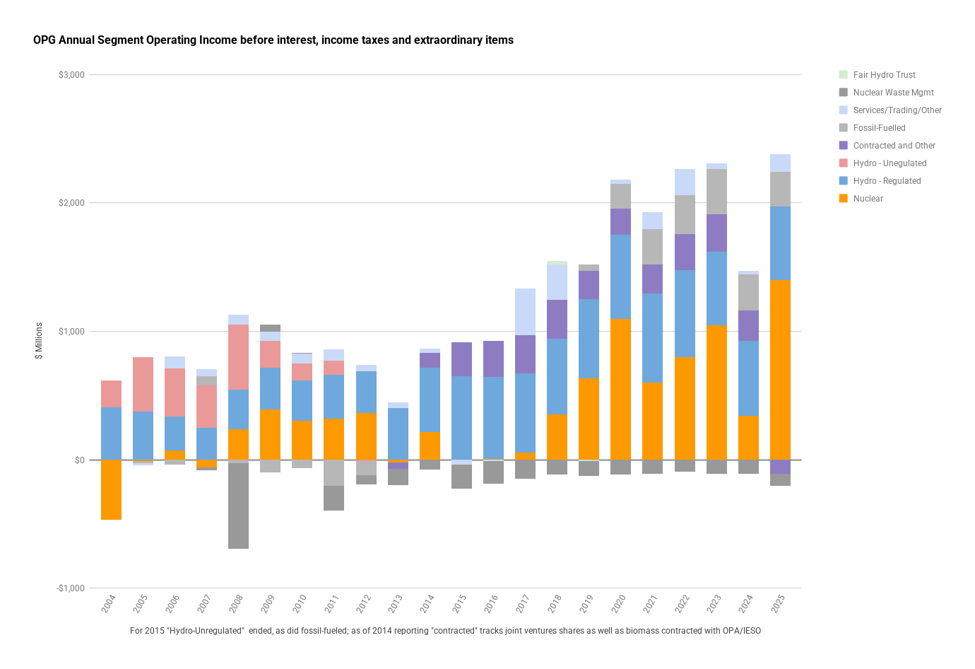
The two reactors that went offline earlier this month, without explanation, could be indicative of large unforeseen problems. Alternatively, OPG has a problem of being too successful in the first 45 months of the 50 month rate period, facing a clawback of profits above the Return-on-Equity (RoE) range the OEB used in setting rates. Half of a profit may be better than no profit at all, but with a current rate below $130/MWh, and an ask above $200/MWh next year, there’s a large incentive to move forward needed outages.
The rate-setting process is conceptually fairly simple: OPG accounts for the planned costs (operating, capital, etc.), an RoE percentage is tagged on, and that gets divided by forecast production to produce a rate. The devil is in the details: what is recoverable cost (should capital cost recovery occur before an asset enters operation), what is production likely to be, and of particular interest to me – considering Ontario Hydro’s demise – what is equity? To maximize rates, OPG ought to maximize equity, maximize expenditures, and minimize production forecasts. The greater their success in doing so, the more logical 1 in 4 refurbished reactors at Darlington being operational this August becomes.
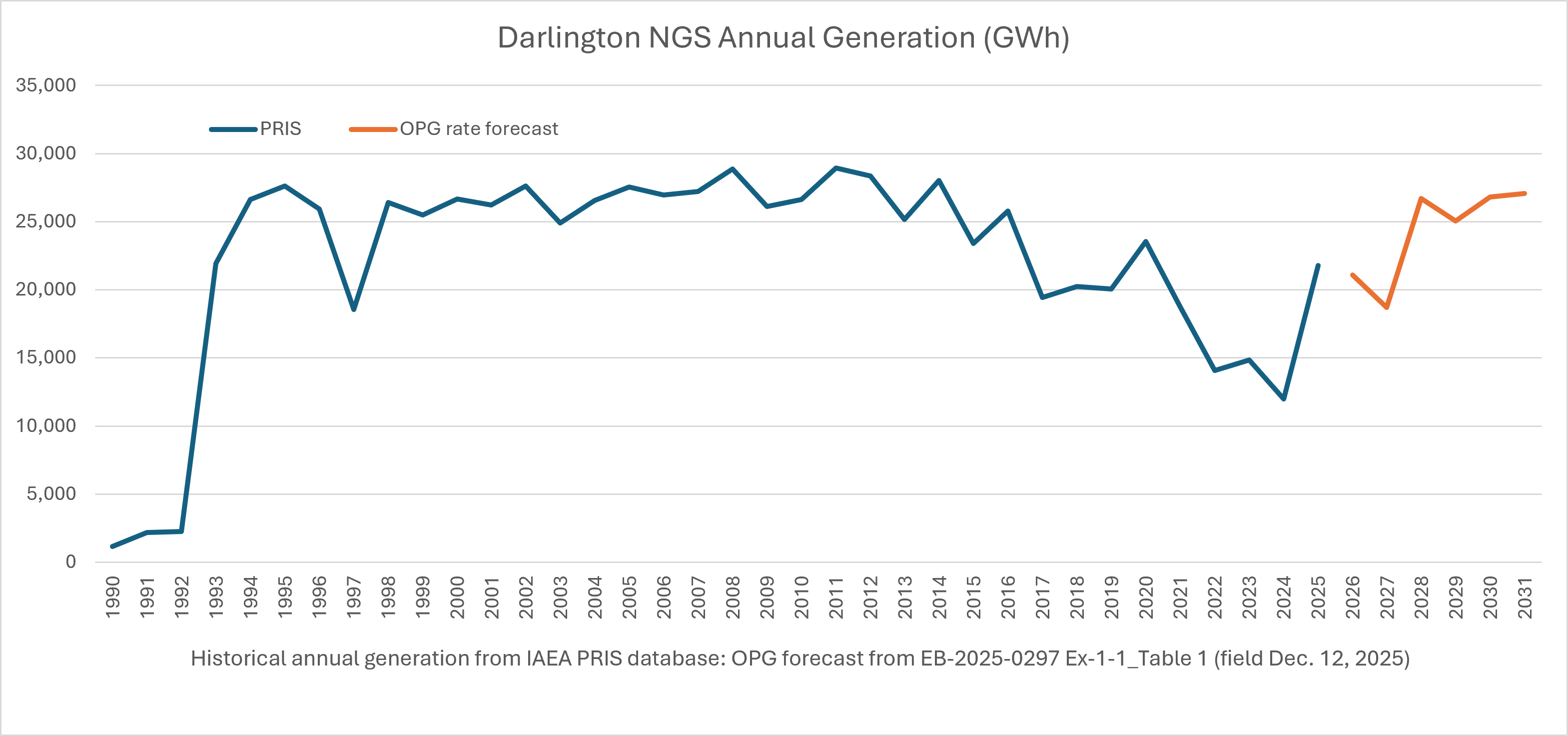
OPG’s production forecast for 2027-2031 is unambitious, particularly for 2027. The first 5 years of the fully refurbished Darlington NGS is planned to have a lower 5-year running total of any 5 years of 4-reactor operation since 2001. Dumbing down the denominator to achieve a higher rate is easier to demonstrate than the other numbers before the OEB.
The two reactors that went offline earlier this month, without explanation, could be indicative of large unforeseen problems. Alternatively, OPG has a problem of being too successful in the first 45 months of the 50 month rate period, facing a clawback of profits above the Return-on-Equity (RoE) range the OEB used in setting rates. Half of a profit may be better than no profit at all, but with a current rate below $130/MWh, and an ask above $200/MWh next year, there’s a large incentive to move forward needed outages.
The rate-setting process is conceptually fairly simple: OPG accounts for the planned costs (operating, capital, etc.), an RoE percentage is tagged on, and that gets divided by forecast production to produce a rate. The devil is in the details: what is recoverable cost (should capital cost recovery occur before an asset enters operation), what is production likely to be, and of particular interest to me – considering Ontario Hydro’s demise – what is equity? To maximize rates, OPG ought to maximize equity, maximize expenditures, and minimize production forecasts. The greater their success in doing so, the more logical 1 in 4 refurbished reactors at Darlington being operational this August becomes.
OPG’s production forecast for 2027-2031 is unambitious, particularly for 2027. The first 5 years of the fully refurbished Darlington NGS is planned to have a lower 5-year running total of any 5 years of 4-reactor operation since 2001. Dumbing down the denominator to achieve a higher rate is easier to demonstrate than the other numbers before the OEB.
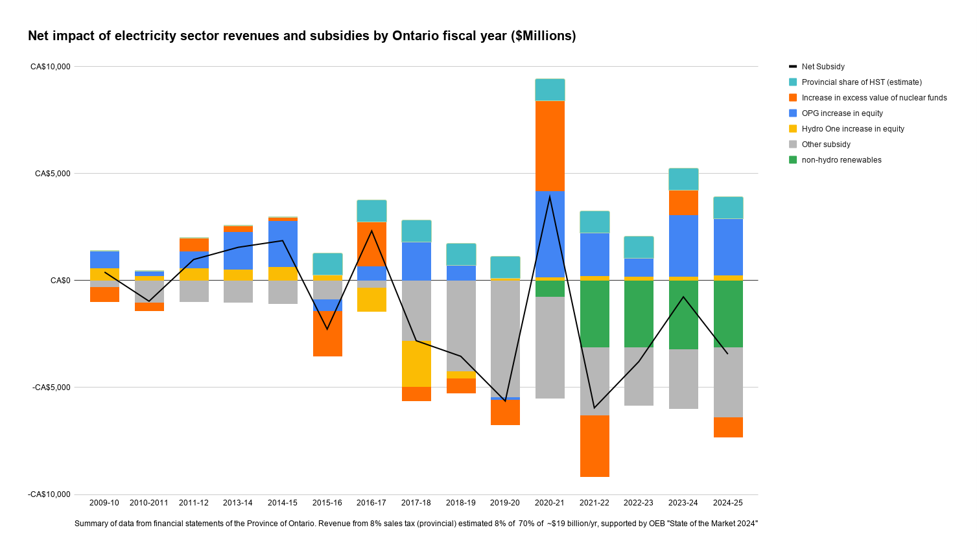
OPG is a government-owned enterprise that records enormous profits based on escalating rates for consumers who are subsidized by the government.
Concluding thoughts
Scanning OPG’s latest financial reporting, for the second quarter of 2026, there are all sorts of games being played around revenue affected by the rate decisions to be made. Profits from the operation of Pickering NGS is taken out of the period’s financial reports under the reasoning it wasn’t expected to operate this long when the rates were set 5 years ago when rates were set. Unfortunately it directly relates to the province’s direction to the OEB to allow OPG to recover costs incurred in the experiment in constructing small modular reactors, and refurbishing Pickering, starting with 2026.[1] This obviously will not end up benefitting 2027’s rate payers – but perhaps those starting 4 or 5 years from now.
The reduction in nuclear output, and resulting loss of revenue within the year, is more than compensated for by deeming an additional $2.4 billion of the nuclear funds (decommissioning and waste) as “due to province.”
We are a long way from OPG acting in the best interests of electricity ratepayers. The look of very expensive nuclear is one nuclear advocates should dislike. Worse than the expense alone is coupling it with lousy performance as only 1 of 4 newly refurbished reactors operates this August. It would be best if OPG came up with a reason, real or imagined, before the narrative that killed Ontario Hydro resurfaces to take them out.
As a longtime Ontario electricity commentator supportive of nuclear power I’ll end by noting that OPG currently has 3 initiatives: the SMR building at Darlington, the refurbishment of Pickering, and developing a new build project at Wesleyville. Of the 3, my recollection is only the SMR was originally supported by OPG. The refurbishment of Pickering was lobbied for by, most prominently, Canadians for Nuclear Energy – I was not active in that lobbying but am comfortable in stating that OPG was opposed to it. Prior to publicly disclosing a plan for a large nuclear power plant on its Wesleyville property, OPG had an agreement to sell off the site as surplus, but was prevented from proceeding by the Ontario government.
Apparently OPG has since decided to aspire to be a nuclear champion.
One of four newly refurbished reactors at Darlington is operating this August.
Footnotes
[1] From OPG 2026 Q2 report: “In December 2025, the Province amended Ontario Regulation 53/05 under the Ontario Energy Board Act, 1998 (Ontario Regulation 53/05) to prescribe DNNP LP as a new OEB rate regulated electricity generator, subject to the OEB’s satisfaction that DNNP LP has met certain conditions, and to set out certain additional requirements the OEB must follow in setting regulated prices for the DNNP SMR facilities and OPG’s existing nuclear facilities. Among these new requirements, the Province amended Ontario Regulation 53/05 to establish a mechanism for recovery through regulated prices of interest amounts in respect of the capital expenditures on the refurbishment of Units 5 to 8 of the Pickering nuclear generating station (Pickering GS) and the capital expenditures on the DNNP prior to such assets being placed in service, effective January 1, 2026. Under the mechanism, the OEB-approved revenue requirement used to set regulated prices for OPG’s existing nuclear facilities and the DNNP facilities must include an amount equal to the product of such forecast cumulative capital expenditures and OPG’s cost of long-term borrowing approved by the OEB.”
[1] OPG 2025 Financial Results (PDF)
[1] The Hydroelectric Contract Initiative signed most sites by early in 2010.
[2] Nuclear Ontario: province contracts Bruce Power through 2064 –[feeling old as most links in my older blog posts have gone dead]
[3] Nuclear Ontario: Government approves Darlington refurbishment
[4] The 2016 application if OEB file EB‑2016‑0152; 2021’s is EB-2021-0032, and the current application for 2027-2031 rates, is EB-2025-0297
[1] That revenue was insufficient, and more debt was loaded onto the OEFC, which is the legal successor to Ontario Hydro (and therefore the vessel holding the ‘stranded’ debt). Trebilcok, Hrab: Electricity Restructuring in Canada
[2] Dwight Duncan, Choosing What Works for a Change
[3] Ministry of Energy as quoted in Trebilcok, Hrab: Electricity Restructuring in Canada
[1] I wrote on it that day – annoyed that not only had the final unit not returned to producing power, but OPG had taken a unit at PNGS out of service earlier that morning: A premature celebration of Darlington’s rebirth
[2] https://www.opg.com/documents/2026-second-quarter-financial-results-pdf/
[3] I wrote on the period up to 1960 in Ontario: The nuclear Side (part 1) – almost 2 years ago. I envisioned part 2 as the growth through Darlington, part 3 as the period of the Wreck of Ontario Hydro, with part 4 building to the optimism of building new nuclear, and extending Pickering. A need for a part 5 is now emerging.
[4] If I recall correctly the stated budget at that time was approximately $7 billion – the much lower figures preferred by opponents of all nuclear power came long before a final investment decision.
[5] Maurice Strong, Nuclear power, competition and sustainable development (8 September 1995)
[1] Commentary here is based on a set of reports from the Independent Electricity System Operator (IESO): the Generator Output and Capability reporting shows the units going offline, while the Adequacy reporting indicated the outages were not planned – and strongly suggests the units are not due back within the next 30 days.
spreadsheet for much of the data work, and some of the graphics, in this post
Your newsletter continues to be one of the most insightful places for news and info on Ontario's grid. Thanks again, Scott!
An excellent historical based documentary.
Ed