


There is a saying that “history is written by the victors.” This seems untrue when Ontario’s electricity system is discussed, which occurs more frequently as more people look for effective ways to decarbonize electricity. Ontario’s system emits relatively low emissions, with a relatively high share of supply coming from nuclear power plants. As Ontario gets explored as a possible model for systems seeking to decarbonize, we need a better story of how Ontario’s electricity system developed as it did.
The history of electricity in Ontario began with private businesses providing limited services to those who could afford it. Power was expensive and under the control of a private “syndicate”. Here, as elsewhere, this led to cities and towns seeking to control their own systems, and many locations did develop some type of public distribution system. Unique to Ontario was the potential of Niagara Falls, which Wilhelm Siemens had estimated to be capable of generating “as much power as all the coal mined in the world.”[i] In 1885 the area surrounding the falls had become publicly managed following the passage of “An Act for the preservation of the Natural Scenery about Niagara Falls”. The sale of bonds had financed the land purchases and works to establish the Queen Victoria Niagara Falls Park – a structure for financing public projects that would be used to finance public electricity a few decades later.[ii]
The power of Niagara did not come easily: first the new Parks authority sold off exclusive rights to develop power on the Canadian side, and when those rights-holders failed to meet their obligations, it sold off some non-exclusive rights at the turn of the century. By 1902 the main opposition party in the legislature, was proposing legislation that stated the electricity from “the waters… be utilized directly by the Provincial Government in order that the latter may generate and develop electricity and pneumatic power for the purpose of light, heat, and power, and furnish same to municipalities in this Province at cost.” The Liberal government of the day, led by Sir George William Ross, rejected that proposal, and while it survived the next election it with the slightest of majorities, among the increased opposition a new face appeared in Adam Beck. Beck did not initiate the public power movement, but became its greatest champion. When the Conservatives defeated the Ross government in 1905, the new Premier, James Pliny Whitney, declared, “that the water power all over the country should not in the future be made the sport and prey of capitalists and shall not be treated as anything else but a valuable asset of the people of Ontario.” Beck was appointed a Minister in the new government which quickly led to the formation of the Hydro-Electric Power Commission of Ontario (HEPCO - later to be known as Ontario Hydro), with Adam Beck as Chairman.
There were many plebiscites in cities and towns across the province as the public power quickly expanded. Within a decade of HEPCO’s creation, the population was asked to vote on the construction of the world’s largest hydro-electric generating project. “Yes”. The facility is still with us, as Sir Adam Beck I Generating Station, more than a century after the first turbines entered service. The project was built by HEPCO, but the estimated $20 million cost ended up closer to $76 million. The government changed during the construction, with a leaderless United Farmers of Ontario party unexpectedly winning an election. Their Premier, E.C. Drury, would eventually appoint a Hydro-Electric Inquiry Commission to investigate the gap between the estimates and costs. The final report of the Commission, delivered under after government returned to the Conservatives, would be fully supportive of public electricity.
The Liberal party returned power under Mitch Hepburn in 1934. Hepburn had been a fierce critic of HEPCO with the allegations that are common in attacking incumbent entities during troubled times: prices were too high, contracts (with Quebec producers) were too expensive, and amount of power procured excessive. Once in power he cancelled the contracts and ordered the new head office of HEPCO be shortened by 7 stories. As demand recovered along with the recession-era economy, the contracts came back – and the building built to the originally planned height. After the Progressive Conservatives, under George Drew, were restored to government in the election of 1943, they remained in power for over 4 decades.
Drew’s government would see 2 enormous projects creating electricity generating stations. During the Second World War the Niagara river was increasingly examined both to improve electricity output, and to maintain a flow over the entire falls area. In 1950 the Niagara Treaty was signed, which allowed the building of Ontario’s largest hydro-electric generating station. Sir Adam Beck II GS is three times larger than Sir Adam Beck I – which had been the largest generating station in the world only 3 decades earlier. 3 years after Beck II GS entered service the largest generating station in the world title would belong to the new station on the American side of the Niagara river (now named The Robert Moses Niagara Power Plant). Beyond the other end of Lake Ontario, a greater project was finally undertaken. It took the Canadian Parliament to initiate a St. Lawrence seaway project before agreements with the Americans allowed the joint work that would lead to, as part of the overall seaway project, the R.H. Saunders Generating Station on the Canadian side of a kilometer long dam containing the St. Lawrence- Franklin Delano Roosevelt Power Project on the American side.
The concrete accomplishments of the Hydro-Electric Power Commission of Ontario are impressive, but the accomplishments of providing an example of public power should also be considered. In 1931 New York Governor, FDR (Roosevelt) had established the New York Power Authority (NYPA). FDR was well aware of Ontario’s population having cheaper electricity rates than his New York constituents, and as the Democrat’s Presidential candidate in 1932 he did lash out at investor-owned utilities.[iii] It was the NYPA that built, and continues to operate, the large US counterparts to Ontario’s generators on the Niagara and St. Lawrence, and two new deal entities created under FDR’s presidency, the Tennessee Valley Authority (TVA) and Bonneville Power Administration (BPA), remain strong public power institutions. FDR’s presidency also saw the creation of the Rural Electrification Administration - another area where FDR was aware of American regions lagging far behind Ontario.
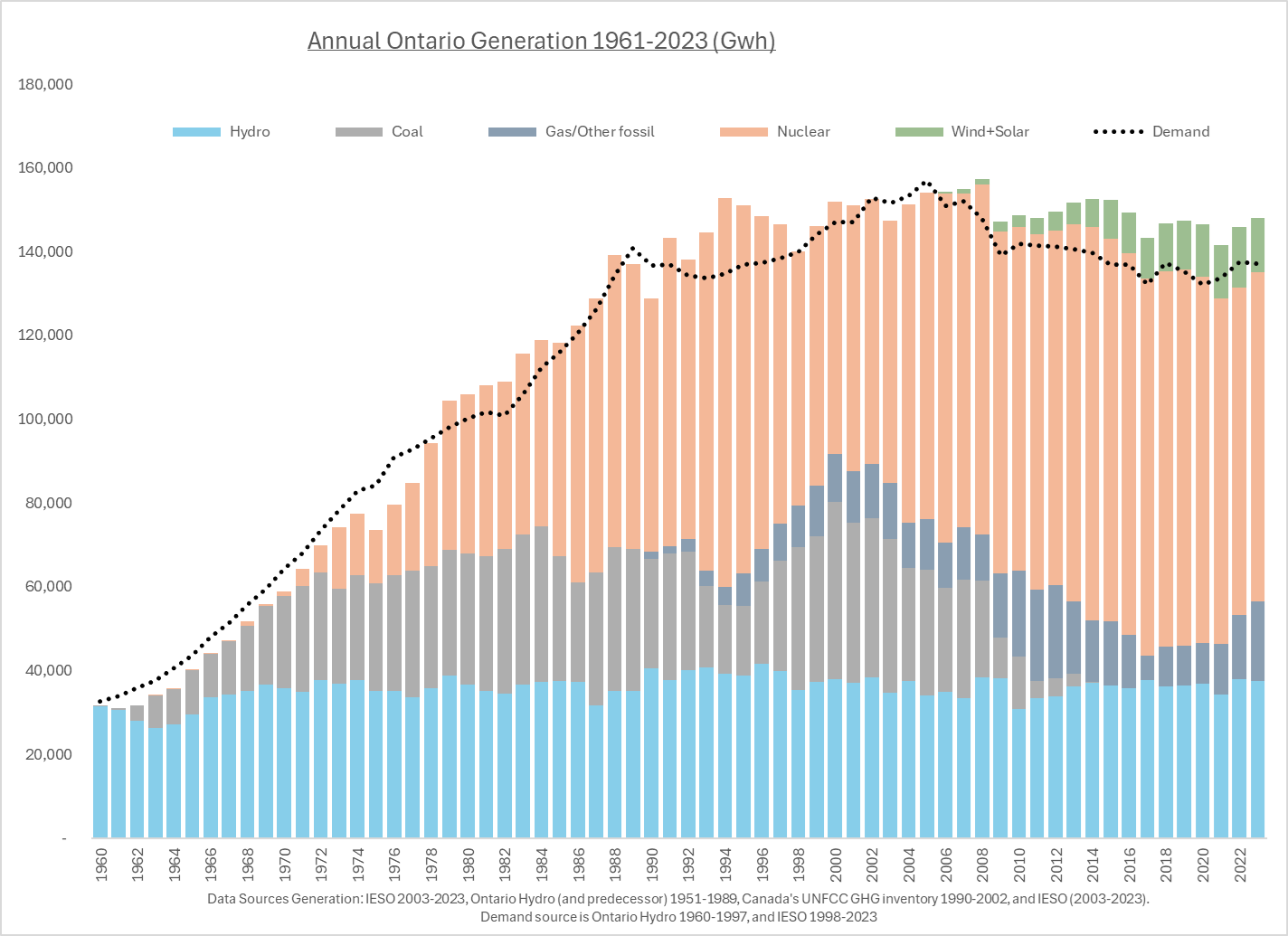
As the 1960’s appeared the era of Ontario being run almost exclusively on hydro-electric power ended. The Annual Report of HEPCO for 1959 noted a transition was happening:
It was a year of more than usual significance as two remarkable projects were brought to completion in 1959 - the program of construction at the St. Lawrence Power Project, which has been a subject of international interest for more than half a century, and the standardization of frequency in the province at 60 cycles per second, one of the largest operations of its kind ever undertaken. The importance of the Saint Lawrence Power Project as an outstanding example of achievement through international cooperation and goodwill was most appropriately marked on June 27 by the visit of Her Majesty Queen Elizabeth II and His Royal Highness the Prince Philip. In the presence of the honorable Richard M. Nixon, Vice-President of the United States, and a large gathering of distinguished visitors Her Majesty unveiled at the international boundary an inscription commemorating the international aspect of the project. In that same month the Commission announced that it would cooperate with Atomic Energy of Canada limited in the construction and operation of a 200,000-kilowatt nuclear-electric station at Douglas point on the shore of Lake Huron between Kincardine and Port Elgin. The first two events mark the close of an interesting and colourful period in the Commission's history; the third foreshadows important future developments that will undoubtedly take place in a challenging but still relatively uncharted field of power generation.
Transitions aren’t immediate: new hydro-electric generation would continue into the 1970’s, albeit at a slower pace, and some coal-fired generating stations had appeared in the 1950’s; but it’s useful to measure everything after 1960 in relation to 1960.
next up: Ontario’s nuclear era begins
[i] Sausages Schnitzels & Public Power: A brief history of Ontario Hydro’s first 75 years, by Gordon Donaldson (appended to Ontario Hydro’s 1980 Annual report)
[ii] Public Power: The Fight for Publicly Owned Electricity. Howard Hampton
[iii] Franklin D. Roosevelt, Electric Utilities, and the Power of Competition, by William M. Emmons III. The Journal of Economic History, Vol. 53, No. 4 (Dec., 1993), pp. 880-9070